Beast Of Busco

Description

The Beast of Busco is a cryptid from Churubusco Lake in Churubusco, Indiana. It was first sighted in the 1940s, though there are rumors of reports dating back to 1898. It is described as a large snapping turtle, about 6 feet by 4 feet across and being covered in moss.

Behavior

The Beast of Busco appears elusive rather than aggressive. Sightings often occurred during calm summer mornings or evenings. It’s reported that the turtle surfaced briefly, sometimes long enough for a clear look, then vanished.

Aliases

Oscar

First Sighting

Legend has it that in 1898 a farmer named Oscar Fulk saw a giant turtle living in the seven-acre lake on his farm near Churubusco. He told others about it, but eventually he decided to leave it alone.

A half century later, in July 1948, two Churubusco citizens, Ora Blue and Charley Wilson, also reported seeing a huge alligator snapping turtle weighing an estimated 500 pounds. The landowner, Gale Harris, became fixated on capturing it organizing large-scale efforts that drew national media attention and crowds. Despite using divers, nets, traps, even draining the lake, no evidence of the creature was ever found.

Events Featuring The Beast Of Busco

Hodag

Description

The Hodag is a famous creature from American folklore, especially associated with Rhinelander, Wisconsin. It’s often described as a strange, fierce monster with the head of a frog, thick horns, sharp fangs, the body of a reptile, green eyes, spikes along its back and a long tail with spines. This mythical creature was first discovered in Rhinelander in the late 19th century but may have been roaming the Northwoods before that. The Hodag reportedly breathed fire and smoke and had a pungent smell. He was about 7 feet long, 30 inches tall and weighed in at about 200 pounds.

Behavior

The Hodag is usually described as a dangerous, aggressive forest creature with strange habits.

First Sighting

The Hodag legend started in 1893 when a local lumberjack named Eugene Shepard claimed he captured the beast in the forests around Rhinelander. He and a group of local men used hunting dogs, rifles and squirt guns loaded with “poison water” to attack the Hodag without success. They finally used dynamite to successfully kill the fearsome creature. He even displayed what he said was the creature’s remains.

A few years later Shepard said had captured a live Hodag. He took the captured beast on tour throughout the state including a stop at the Oneida County Fair where attendees paid to see the captured Hodag. This most likely had more visitors than the bearded lady.

Later, Shepard revealed the whole thing was a hoax, and the “creature” was a cleverly built model used to entertain crowds and attract attention. But the legend lived on. For decades, golfers around Rhinelander have blamed the Hodag for disappearing golf balls, and anglers have claimed the beast steals fish off their lines.

Attractions Featuring Hodag

Events Featuring The Hodag

Jersey Devil

Description

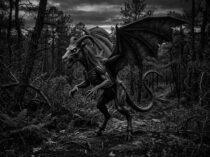
The Jersey Devil is a famous American cryptid said to live in the Pine Barrens in southern New Jersey. Descriptions vary, but most sightings describe a strange creature that of a bipedal kangaroo-like or wyvern-like creature with a horse or goat-like head, leathery bat-like wings, horns, small arms with clawed hands, legs with cloven hooves, and a forked or barbed tail.

Behavior

The Jersey Devil has been reported to move quickly and is often described as emitting a high-pitched “blood-curdling scream”.

First Sighting

The most common story dates to 1735 in the Pine Barrens. A woman known as Mother Leeds supposedly cursed her 13th child, saying “Let it be the devil!”. According to the legend, the baby transformed into a creature with hooves, a goat’s head, bat wings, and a forked tail. He then proceeded to kill the midwife and flew up the chimney into the forest. Historians think the legend may also connect to the real Daniel Leeds family, who were unpopular with local Quakers. Political rivalries and pamphlet attacks may have turned the Leeds family name into a monster story.

One of the biggest waves of sightings occurred during January 1909, when hundreds of people across New Jersey and nearby states reported seeing the creature. Schools closed and police investigated strange tracks. Witnesses included police officers, factory workers, and business owners. No physical evidence was ever confirmed.

Events Featuring The Jersey Devil

Nain Rouge

Description

The Nain Rouge is a small red goblin-like spirit from the folklore of Detroit, Michigan that appears before disasters affecting the city. He is described as being small and red-skinned with sharp teeth, glowing eyes, bat-like ears, and clawed hands.

Behavior

The Nain Rouge is said to be a malevolent, mischievous, and often maleficent creature who is believed to bring extreme bad luck and misfortune to the city of Detroit and its residents.

First Sighting

According to legend, the Nain Rouge was first spotted in Detroit in 1701 by Antoine Laumet de La Mothe, sieur de Cadillac, who founded the city. Cadillac was told by a fortune teller that one day he would cross paths with a tiny red troublemaker. The fortune teller warned him not to mess with the Nain Rouge, however Cadillac unfortunately ignored this advice. Soon after, Cadillac encountered the Nain Rouge near the banks of the Detroit River while out for an evening stroll. He proceeded to hit the Nain Rouge with his cane and told him to get out of his way.

Sure enough bad times followed for Cadillac. He was charged by the high officials of New France with abuse of power and was reassigned to a backwoods outpost in Louisiana. He later returned to France where he was briefly imprisoned and eventually lost his fortune.

Since that encounter with Cadillac, Nain Rouge’s appearance would always mean terrible events for the city. The creature is said to have appeared on July 30, 1763, right before the Battle of Bloody Run where 58 British soldiers stationed at Fort Detroit were slaughtered by Native Americans from Chief Pontiac’s Ottawa tribe. Governor William Hull’s misfortunes leading to the surrender of Detroit to the British in the War of 1812 are blamed on the Nain Rouge. The Great Fire of 1805, the race riots in 1967, Detroit’s economic crash in the 1970’s, the decline of the auto industry, poverty and continuing social issues, crime waves, and even the losing seasons of the Detroit Lions and Detroit Tigers have also been attributed to the Nain Rouge’s curse.

Events Featuring Nain Rouge

Fouke Monster

Description

The Fouke Monster (also called the Boggy Creek Monster) is a Sasquatch-like creature reportedly seen near the town of Fouke, close to the swampy Boggy Creek in southern Arkansas. He is said to haunt the network of creeks extending from the Sulphur River Bottoms in southern Arkansas to the town of Fouke.

Witnesses have described the creature as being about 7–8 feet tall and covered in long dark hair with glowing red or yellow eyes. He is also described as having extremely long arms and a very strong, foul odor.

Over the years, The Fouke Monster has been seen by countless people including experienced hunters, famous musicians, as well as police officer. He was the inspiration for several movies most notably ‘The Legend of Boggy Creek’, a drive-in hit netting nearly $25 million during its run.

Aliases

Fouke Monster goes by other names such as Boggy Creek Monster and Swamp Stalker of Boggy Creek.

Behavior

The Fouke Monster is reported as having similar behaviors to that of Bigfoot. It mostly appears at night (roaming swampy forests instead of wooded areas), makes screaming or howling sounds, “knocks” on trees and occasionaly leaves large footprints. Some witnesses also said the creature could run very fast despite its size.

First Sighting

The legend became widely known after a series of sightings in the early 1970s. In 1971, a man near Fouke reported that a large hairy creature who breathed heavily and had red eyes, scratched at the house windows, looked inside the home and left large three-toed footprints. The man broke free from the creature and ran reporting that he ran so fast that he did not stop to open the front door but rammed right through it. He was treated at a local hospital for minor scratches and shock.

Attractions Featuring Fouke Monster

Events Featuring Fouke Monster

Mothman

Description

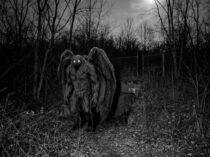
The Mothman is a famous cryptid first reported in 1966 in Point Pleasant, West Virginia. Witnesses described a strange large winged humanoid creature standing about 6-7 feet tall with glowing red eyes and a small or almost non-existent neck. The sightings became one of the most well-known paranormal stories in the United States.

Behavior

Mothman has some peculiar behaviors reported such as: watching people silently from roofs or trees, following cars at high speed, flying between buildings or over highways, and making high-pitched screeching sounds.

First Sighting

The first major encounter with Mothman came on November 15, 1966 when two young couples claimed they saw a large winged creature near an abandoned TNT plant outside Point Pleasant. They described the creature as a ‘slender, muscular man’ about seven feet tall with huge white wings and glowing red eyes. The couple sped away in their car, and Mothman chased them while making a screeching sound. The couple estimated that Mothman flew over 90 mph.

In late 1967, The Silver Bridge at Point Pleasant collapsed which was a huge tragedy. The bridge was carrying far more load than it should have and a tiny manufacturing defect led to the collapse that killed 46 people. There are claims that Mothman was there to warn people and that he’d been spotted near the bridge shortly before the collapse.

Attractions Featuring Mothman

Events Featuring Mothman

Frogman

Description

The Loveland Frog, often called the Frogman, is a strange humanoid frog creature reported near the city of Loveland along the Little Miami River. Witnesses describe it as being about 3–4 feet (1–1.2 m) tall, green or gray skin, frog-like head with large eyes, webbed hands and feet, and standing or walking upright like a human.

Behavior

The frogmen have the physical ability to use sticks like tools. They can use those sticks to emit sparks like a wand.

First Sighting

The first sighting was by a businessman driving along a stretch of road that runs along the Miami River in Clermont County late at night in May 1955. The man spotted three bipedal figures with leathery skin and frog faces congregating by the side of the road. The man pulled his car to the curb and observed these creatures for about three minutes. Just as he was about to leave, one of the creatures suddenly held a “wand” above its head. Sparks spewed out of the end of this wand.

Events Featuring Frogman

Bigfoot

Description

The Bigfoot—often called Sasquatch—is one of the most famous cryptids in the world. It’s said to be a large, hairy, human-like creature that lives in remote forests, especially in the Pacific Northwest of United States and Canada. Common descriptions include broad shoulders, no visible neck, long arms, and even glowing yellow or red eyes.

Aliases

Bigfoot goes by other names depending on who spotted it and where it was spotted. Other names for Bigfoot include: Almas, Boggy Creek Monster, Fouke Monster, Hibagon, Momo, Ngoui Rung, Old Yellow Top, Skunk Ape, Sasquatch, Swamp Stalker of Boggy Creek, Wood Booger, Yeren, Yeti, and Yowie

Behavior

The reported behavior of Bigfoot mostly comes from eyewitness reports, folklore, and investigations by groups who portray Bigfoot with the following behaviors:

  • Extremely Elusive – One of the most commonly reported traits is avoidance of humans. Bigfoot prefers to stay in remote forests and mountains. He moves quietly yet quickly and disappears before being clearly seen.
  • Nocturnal – Many reports say Bigfoot is most active at night. Strange howls or screams can be heard in the distance. Because of this, some researchers think sightings happen in deep wilderness like the Pacific Northwest, especially in Washington and Oregon.
  • “Wood Knocking” – A unique behavior reported by witnesses is wood knocking which involves loud knocks on trees. Some believe it could be a form of communication, similar to how gorillas beat their chests.
  • Large Strides and Tracks – Tracks attributed to Bigfoot often show very long strides (up to 4–6 feet apart) with deep impressions in the soil.

First Sighting

Stories and folklore surrounding Bigfoot go back hundreds or even thousands of years. The modern history of Bigfoot in Oregon begins in 1904 with sightings of a hairy “wild man” by settlers in the Sixes River area in the Coast Range. In 1924, miners on Mount St. Helens claimed to have been attacked by giant apes. In 1958, woods workers east and west of the Cascade Mountains reported seeing creatures and discovering their footprints along logging roads. Witnesses observed these creatures crossing roads at night, stepping through the forest and mountain areas, or foraging for food in rock piles. Newspapers started calling the creature “Big Foot.”

This incident led to the famous 1967 footage known as the Patterson–Gimlin Film. On October 20, 1967, Bigfoot enthusiast Roger Patterson and his partner Robert Gimlin were filming a Bigfoot docudrama in Bluff Creek. The pair claimed they came upon a Bigfoot and filmed the encounter. The minute long video has become iconic in popular culture and Bigfoot related lore.

Other Documented Sightings

A youth group was camping in the Marble Mountain Wilderness, California when their leader noticed a strange-looking creature along a ridge nearby. He filmed it for nearly seven minutes.

While trekking through the Himalayas in 1951, British explorer Eric Earle Shipton took a photo of what appeared to be a Yeti footprint. In 2014, Christie’s Auction house in London sold the original photo for nearly $5,000.

In 2007, a hunter captured some of the most famous bigfoot images to date with a camera mounted to a tree in Pennsylvania’s Allegheny National Forest. Skeptics believe the animal was just a bear sick with mange.

A footprint measuring 17.75 inches was found near a residential home in 1980. The footprint coincided with reports of strange noises and a strong but unusual odor in the area.

In 1994, a former U.S. Forest patrolman he saw a family of bigfoots in Washington’s Blue Mountains. The video is shaky and grainy but has been deemed real by Bigfoot experts.

A Mississippi resident captured video of a potential Bigfoot while hunting on his property in 2013. Afraid to go back to the woods, he posted the footage to YouTube asking for help to identify the animal.

In 2012 a hiker was walking through the Utah Hills near Provo Canyon when he spotted a large animal in the woods. As he got near, the animal stood up hind legs and started throwing rocks at him.

Attractions Featuring Bigfoot

Events Featuring Bigfoot